H-1B Visa Fee in 2025: What It Is Now, What Changed, and Which Countries Will Be Hit the Hardest

The U.S. has introduced a new $100,000 fee for new H-1B visas. Here’s the full cost breakdown (old + new fees), who it applies to, and which countries—especially India and China—will be most affected, with caveats for existing holders.
If you hire or aspire to work in the U.S. on an H-1B, the fee landscape just changed—dramatically. In mid-September 2025, the White House unveiled an additional $100,000 fee on new H-1B visas (beneficiaries outside the U.S.), on top of the usual USCIS charges. After early mixed messaging, officials clarified that the $100,000 is a one-time fee for new applicants, not for renewals or current holders re-entering.
Below, we unpack: (1) what the “current” H-1B fees look like now, (2) who exactly pays the new charge, (3) how your total cost stacks up, and (4) which countries (and industries) will feel the burn.
1) The “current” H-1B fee stack (USCIS components still apply)
Even before the new policy, H-1B costs varied by employer size and petition type. Core components included:
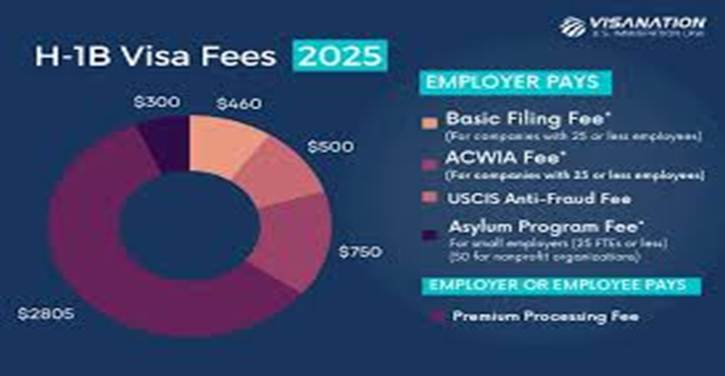
- H-1B Registration (cap season): $215 (from March 2025; previously $10).
- Form I-129 base fee: generally $780 after the 2024 USCIS fee rule (some small employers/nonprofits may see $460 tiers referenced in university/law-firm guides; always check the live fee table).
- ACWIA training fee: $750 (≤25 employees) or $1,500 (≥26 employees); certain research/nonprofit/education employers are exempt.
- Fraud Prevention & Detection fee: $500 (initial grants; some scenarios).
- Public Law 114-113 fee: $4,000 for H-1B “dependent” employers (50+ U.S. employees with >50% in H-1B/L-1).
- Asylum Program fee (added in 2024 rule): typically $600 (large employers) or $300 (small), $0 for nonprofits.
- Premium Processing (optional): $2,805 for 15-business-day action.
USCIS keeps a live Fee Schedule (Form G-1055) you should verify at filing time.
2) What changed: the new $100,000 fee (who it hits—and who it doesn’t)
- Applies to: New H-1B visas for workers outside the U.S. (initial entry). The White House clarified it’s one-time, not annual.
- Does not apply to:
- Existing H-1B holders (including those traveling internationally and re-entering).
- Renewals/extensions of visas issued before the policy date.
- Rationale & pushback: Officials framed it as protecting U.S. workers; industry groups warn of major disruption to innovation, especially in tech. India’s government and IT body NASSCOM flagged humanitarian and business impacts.
Bottom line: If the beneficiary is already in the U.S. changing status/continuing employment, the extraordinary $100,000 charge likely doesn’t apply. If they’re outside and this is a new H-1B, it does.
3) What employers really pay now: two quick scenarios
These are illustrative totals (your actual mix can differ based on employer size, dependency status, cap vs non-cap, exemptions, etc.). We’re showing the new $100k only where it applies.
A) New cap-subject hire outside the U.S. (large employer, not H-1B-dependent)
- Registration: $215
- I-129: $780
- ACWIA: $1,500
- Fraud: $500
- Asylum Program fee: $600
- New $100,000 fee (applies): $100,000
- Premium Processing (optional): $2,805
Illustrative subtotal (w/out premium): ~$103,595; with premium: ~$106,400.
B) Extension/continuation inside the U.S. (same employer, large, not dependent)
- Registration: $0 (no cap lottery)
- I-129: $780
- ACWIA: $1,500 (or exempt in some cases)
- Fraud: $0 or $500, depending on posture
- Asylum Program fee: $600
- New $100,000 fee: Not applicable (existing holder)
- Premium Processing (optional): $2,805
Illustrative subtotal (w/out premium): ~$2,880 to $3,380; with premium: add $2,805.
For H-1B-dependent employers (50+ U.S. employees with >50% on H-1B/L-1), add $4,000 (PL 114-113) to scenarios where it applies.
4) Who suffers—and who doesn’t
Hardest-hit employers
- Outsourcing/IT services firms that regularly onboard talent from abroad will see the full $100,000 per new entrant—a structural shock to their business model. Reuters
- Startups/SMBs needing niche skills from overseas may find the cost prohibitive, dampening U.S. competitiveness.
- Cap-season recruiters who planned cohorts overseas for October starts could face abrupt budget overages or cancellations.
Less impacted
- Existing H-1B holders (including travel re-entry) and extensions/changes of status inside the U.S.—explicitly carved out.
- Deep-pocketed big tech may still sponsor select hires where the ROI justifies the $100k; impact shifts to volume hiring rather than top-tier roles. (Inference based on clarifications + firm advisories.)
Possible exceptions
- National-interest waivers/exemptions could narrow the application in some cases, but details remain policy- and adjudication-dependent. (Watch for agency guidance and litigation.)
5) Which countries will be severely affected
Data context: India dominates H-1B flows. In FY-2023, ~72–73% of approved H-1Bs were for beneficiaries born in India; China was next at ~12%. The remaining top eight countries combined were only ~6–7%. That means any shock to new H-1B entries will skew heavily toward Indian and, secondarily, Chinese nationals.
- India (most severely affected):
- Scale: ~70%+ share of approvals.
- Sectoral exposure: Indian IT services and consulting companies that routinely rotate fresh talent from India to U.S. projects are directly in the fee’s crosshairs. Government and industry bodies (MEA, NASSCOM) have already warned of disruptions for families and employers.
- Knock-on effects: Some firms may accelerate near-shoring (Canada, Mexico) or reshoring to India instead of bringing workers to the U.S. (a pattern seen when H-1B tightens).
- China (significantly affected):
- With ~12% share, Chinese nationals are the second-largest group. New offshore hires face the same $100k hurdle, likely pushing employers to prefer candidates already in the U.S. (OPT to H-1B transitions) or to reallocate work to China-based teams.
- Everyone else (moderately affected as a group):
- Philippines, Canada, Mexico, Brazil, Nigeria and others make up small single-digit shares individually. The fee still bites, but macro exposure is lower because their combined numbers are relatively small compared to India/China.
Key nuance: Because the $100k applies to new offshore entries, international students already in the U.S. (F-1/OPT) who change status to H-1B may avoid the $100k, reducing impact for those cohorts—again tilting the pain toward offshore pipelines. (Based on White House clarifications distinguishing new entrants from existing holders/renewals.)
6) Market reactions & what to watch next
- Corporate travel advisories: Several large employers reportedly asked H-1B staff to stay in or return to the U.S. amid uncertainty—now partially eased by the clarification for current holders.
- Policy stability: Early statements described the fee as “annual,” later corrected to one-time—expect litigation and further guidance.
- USCIS implementation details: Watch for form updates, lockbox payment handling, receipts (the Fee Schedule page and G-1055 PDF are the official sources to check before filing).
7) Practical takeaways (employers & applicants)
- If recruiting abroad for new H-1Bs: Budget +$100,000 per new entrant, plus normal USCIS fees; reconsider start dates, remote allocations, or hire from U.S.-based talent pools (e.g., STEM OPT) to avoid the surcharge.
- If you’re a current H-1B holder: The White House says the new fee won’t hit you for extensions or re-entry. Still, carry evidence of your existing status and watch for carrier/consular confusion in the early weeks.
- Double-check your fee mix: ACWIA, PL 114-113, and Asylum Program fees can vary by employer type/size; don’t rely on generic checklists. Use USCIS’s latest tables.

FAQs
Q1) What is the H-1B fee right now for a brand-new hire outside the U.S.?
A: Add normal USCIS fees (registration $215 if cap-subject, I-129 base often $780, ACWIA $750/$1,500, fraud $500, asylum program $300/$600, PL 114-113 $4,000 if dependent, optional premium $2,805) plus the new $100,000 one-time fee for new entrants. Exact totals vary by employer profile.
Q2) Does the $100,000 fee apply to extensions, amendments, or existing H-1B holders who travel?
A: No, per the White House clarification—it’s only for new visas (new entrants).
Q3) Is the $100,000 charge annual?
A: Initial statements created confusion; subsequent clarification indicates one-time. Monitor official guidance in case of further updates or litigation.
Q4) Which countries are most affected?
A: India (by far), then China, due to their dominant shares of H-1B approvals. Others (e.g., Philippines, Canada, Mexico, Brazil, Nigeria) are impacted at a smaller scale.
Q5) Any way around the $100,000 fee?
A: Not for new offshore H-1Bs. But if a candidate is already in the U.S. (e.g., F-1/OPT) and changes status, the surcharge doesn’t apply based on current guidance. Also watch for national-interest exceptions if any are formalized.
For more such amazing content visit : https://insightsphere.in/






Post Comment