Chhath Puja – The Festival of Faith, Sun, and Sustainability

🌞 1. What Is Chhath Puja 2025?
Chhath Puja 2025 is one of the most ancient and revered Hindu festivals dedicated to Lord Surya (Sun God) and Chhathi Maiya, believed to be the sister of Surya Dev. The festival is observed with deep devotion mainly in Bihar, Jharkhand, Eastern Uttar Pradesh, and Nepal, but today it’s celebrated globally by the Indian diaspora.
The word “Chhath” literally means “sixth,” as it is celebrated on the sixth day after Diwali in the Hindu lunar month of Kartika (October–November).
🌅 2. The Deep Significance of Chhath Puja
Unlike many other Hindu festivals, Chhath Puja 2025 does not involve idol worship. Instead, devotees express gratitude directly to nature — to the Sun, the source of all energy and life.
The Sun God is offered Arghya (water offering) during sunrise and sunset, symbolizing the balance between light and darkness, creation and destruction, birth and death.
It also represents sustainability, as devotees perform all rituals near rivers, ponds, or natural water bodies without artificial decorations or pollution.
🕉️ 3. Historical and Mythological Roots
The origins of Chhath Puja date back to the Rig Veda, where rituals for the Sun are mentioned as ways to achieve health and prosperity.
Legends connect it to:
- Draupadi and Pandavas in the Mahabharata, who performed Chhath to regain their lost kingdom.
- Karna, the son of Surya Dev, who was known to offer daily prayers to the Sun standing in water.
This makes Chhath Puja 2025 a rare festival that bridges science, spirituality, and ecology.
🪔 4. Four Days of Chhath Puja 2025 Rituals
The festival spans four spiritually charged days, each with deep meaning:
Day 1 – Nahay Khay (Bath and Eat)
Devotees bathe in a river and eat only one meal prepared in the purest form — symbolizing self-purification.
Day 2 – Kharna (Fasting and Offering)
A day-long fast without water, ending after sunset with offerings of gur ki kheer (jaggery pudding), bananas, and chapati.
Day 3 – Sandhya Arghya (Evening Offering)
Women (and many men) stand in water bodies during sunset, offering arghya to the setting Sun with bamboo baskets filled with fruits, sugarcane, and Thekua (traditional sweet).

Day 4 – Usha Arghya (Morning Offering)
Before sunrise, devotees again offer prayers to the rising Sun, marking the end of their fast and thanking nature for its blessings.
💧 5. Scientific and Environmental Meaning
Chhath Puja 2025 also promotes holistic health and sustainability. Fasting detoxifies the body, standing in water balances solar radiation, and facing the rising and setting Sun enhances mental focus.
From an environmental view, the festival promotes:
- River cleanliness
- Biodegradable offerings
- Community hygiene and water preservation
It is often referred to as India’s most eco-conscious festival.
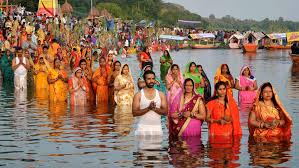
👩👩👧 6. Women Power in Chhath Puja
Chhath Puja 2025 is a celebration of female strength and devotion.
Women, called Parvaitin, lead the rituals with extraordinary endurance — fasting for over 36 hours, maintaining purity, and spreading faith that transcends religion and gender.
🎶 7. The Sound of Devotion
Traditional Chhath geet (folk songs) fill the air — often sung in Maithili or Bhojpuri, these soulful songs narrate stories of faith and family bonds.
Songs like “Kanch hi baans ke bahangiya” and “Uga hain Suruj Dev” are integral to every household observing Chhath Puja 2025.
🌏 8. Chhath Puja Across the World
With the global Bihari community, Chhath Puja 2025 has reached places like Dubai, London, New York, and Mauritius.
Devotees gather near artificial ponds or riversides, proving that faith knows no boundaries — just the devotion toward the Sun.
🌻 9. Chhath Puja 2025 – A Festival of Faith, Health, and Harmony
Chhath Puja 2025 is more than a religious event; it is a spiritual science of body-mind purification, environmental awareness, and community unity.
It teaches us to live in harmony with nature, energy, and humility — making it one of the most meaningful festivals of India.
🪔 Conclusion
As Chhath Puja 2025 approaches, let us remember that this is not just about fasting or rituals — it’s about gratitude, discipline, and respect for nature.
When devotees stand in rivers offering arghya to the Sun, it’s humanity’s silent prayer for a sustainable and peaceful future.
For more such amazing content visit : https://newseeker.insightsphere.in/







Post Comment