Cloud Seeding: The Science of Making Rain from Clouds
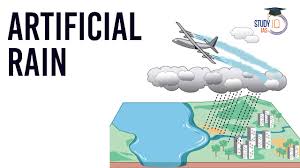
Learn what cloud seeding is, how it works, its benefits and disadvantages, its impact on health, and why Delhi is using artificial rain to fight pollution.
What is Cloud Seeding?
Cloud seeding is a weather modification technique used to artificially induce rainfall from clouds.
It involves injecting chemicals or particles into moisture-bearing clouds to encourage condensation and rainfall.
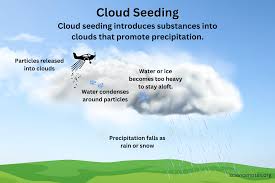
Clouds are made up of tiny water droplets or ice crystals suspended in the atmosphere.
When condensation nuclei (microscopic particles) are present, water vapor condenses around them to form rain.
Cloud seeding enhances this natural process artificially to make rain fall faster or in greater quantities.
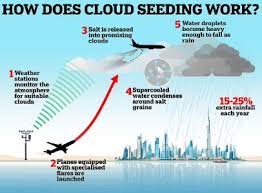
⚙️ How Does Cloud Seeding Work?
In cloud seeding, aircraft, drones, or ground-based generators are used to disperse Silver Iodide (AgI), Potassium Iodide (KI), or Dry Ice (CO₂) into the clouds.
These substances act as nuclei for ice formation, around which water vapor condenses or freezes.
As the droplets become heavier, they fall to the ground as rain or snow.
✈️ Types of Cloud Seeding
| Type | Description | Common Agents Used |
| Static Cloud Seeding | Injecting particles to encourage droplet formation | Silver Iodide |
| Dynamic Cloud Seeding | Enhancing air currents to increase cloud moisture | Silver Iodide |
| Hygroscopic Seeding | Using salt particles to form larger droplets | Sodium Chloride, Potassium Chloride |
🌍 Where Cloud Seeding Is Used
Cloud seeding is used in over 50 countries, including:
- 🇮🇳 India: Rajasthan, Karnataka, Tamil Nadu, Maharashtra
- 🇨🇳 China: Used before the Beijing Olympics to reduce air pollution
- 🇦🇪 UAE: Regular artificial rain operations for drought relief
- 🇺🇸 USA: In California, Nevada, and Colorado for water management
📊 Scientific Data & Results
- Cloud seeding can increase rainfall by 10%–30% under favorable conditions.
- In Australia’s Snowy Mountains, a 5-year study recorded a 14% increase in snowfall.
- In Wyoming (USA), seeded clouds produced 5–15% more snow accumulation.
- India’s IIT Kanpur and IITM Pune have both carried out successful pilot projects.
🌦️ Benefits of Cloud Seeding
- 🌾 Supports agriculture: Provides relief in drought-affected areas.
- 💧 Enhances water reserves: Raises levels in lakes, rivers, and reservoirs.
- 🌫️ Reduces air pollution: Rain helps settle suspended pollutants.
- ✈️ Controls hail and fog: Improves air traffic safety.
- ⚡ Boosts hydropower: Increases water flow for electricity generation.
⚠️ Limitations & Drawbacks
- 💰 Expensive: The cost of inducing rainfall can reach ₹15,000 per square foot.
- Example: Karnataka’s two-year project cost nearly ₹89 crore.
- 🌧️ Uncertain success: Works only if suitable moisture-bearing clouds exist.
- 🧪 Chemical residue: Excessive Silver Iodide may affect soil and water quality.
- ☁️ Disrupts natural rainfall patterns: May increase rain in one area and reduce it elsewhere.
- ✈️ Operational risk: Aircraft-based operations over populated areas can be risky.
🩺 Impact on Health
- Silver Iodide is low in toxicity, but prolonged exposure can affect respiratory or skin health.
- The fine particles may aggravate asthma or allergies.
- Polluted rainwater could affect drinking water quality.
Precautions:
👉 Avoid outdoor activity during or right after seeding.
👉 Use filtered or treated water for drinking.
👉 Individuals with respiratory issues should consult a doctor.
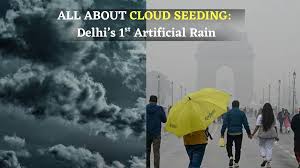
🏙️ Why Delhi is Using Cloud Seeding
Due to rising air pollution, the Delhi government approved artificial rain (cloud seeding) on October 29, 2025.
The project involves IIT Kanpur and the India Meteorological Department (IMD).
The main goals are:
- To reduce air pollution by washing out suspended particles.
- To improve AQI (Air Quality Index).
- To minimize smog and respiratory diseases during winter.
🧠 Interesting Facts
- The concept of cloud seeding was developed in 1945 in the United States.
- India experimented with it in Tamil Nadu (1983–94) and Karnataka (2003–04).
- The UAE now uses AI-powered drone-based seeding systems for precision weather modification.
🌈 Future Scope
Cloud seeding is seen as a strategic tool for tackling water scarcity, agriculture stress, and pollution control.
However, it is not a replacement for natural conservation methods — it’s a supportive technique.
To make it sustainable, cloud seeding should go hand in hand with:
- Rainwater harvesting
- Afforestation
- Pollution control policies
🌦️ Conclusion
Cloud seeding is not magic — it’s science that works hand in hand with nature to bring rain.
When used responsibly and monitored scientifically, it can become a powerful solution to modern environmental challenges.
For more such amazing content visit : https://newseeker.insightsphere.in/







Post Comment