“Rajasthan’s Golden Boom: How a 113 Million Tonne Gold Ore Reserve in Banswara Could Transform the State (What, Why & How)“
Discover the massive gold-ore reserve in Banswara, Rajasthan — 113 million tonnes of ore (~222 tonnes of gold), what it means for mining, economy, jobs & environment. Full deep dive
Deep in the tribal belt of southern Rajasthan lies a discovery that promises to reshape both the local economy and India’s gold-mining map. In the Bhukia‑Jagpura gold belt of Banswara district, geologists have identified more than 113 million tonnes of gold-bearing ore — equivalent to roughly 222 tonnes of gold metal.
In this blog we’ll break down:
- What exactly has been found (quantities, location, geology)
- Why this discovery is significant (economy, mining, industry)
- How mining may proceed (techniques, timeline, regulation)
- Key opportunities & risks (jobs, environment, tribal areas)
- What this means for Rajasthan and India at large.
1. What has been found: The details
✅ Location & resource estimate
- The gold-ore resource is primarily in the Bhukia-Jagpura belt of Banswara district, in the Ghatol tehsil area of Rajasthan.
- The Government of Rajasthan’s Department of Mines & Geology reports about 105.81 million tonnes of ore in the Bhukia-Jagpura-Delwara belt (at a cut-off grade of 0.50 g/t gold) out of a total state estimate of 118.88 million tonnes of gold-ore.
- Independent references mention an estimated 113.52 million tonnes of ore in just one block, containing about 222.39 tonnes of gold metal.
- A recent article reports a third major gold zone found in Kankariya village (also in Banswara) reinforcing this region’s status as a gold-hotspot.
🧪 Grade & geology
- The average grade in the Bhukia-Jagpura zone is mentioned as ~1.95 g/t in one source, meaning about 1.95 grams of gold per tonne of ore.
- The geology: It lies within the Aravalli-Delhi Fold Belt, with gold-copper mineralisation in Precambrian supracrustal rocks.
📍 Other zones
- Apart from Banswara, gold occurrences have been noted as by-products in the Khetri copper belt (Jhunjhunu), and in other districts like Dausa, Alwar, Sikar.
- The broader region labelled the “Salumbar-Ghatol Gold Field (SGF)” spans ~1,270 sq km, includes 8 zones, 26 prospects and aims to eventually define about 1,000 tonnes of gold resource.
2. Why this discovery is significant
📈 Economic potential
- With ~222 tonnes of gold (just in one block), the value is enormous given global gold prices. This provides a strategic domestic source of gold which India largely imports.
- The gold mining boom could trigger job creation (both direct mining jobs and downstream industries such as processing, refining, chemicals) especially in tribal hinterlands like Banswara.
- State revenues: Auctioning mining blocks (like the 472 ha Dugocha block in Salumbar for gold) already shows how the state is monetising mineral wealth.
🏆 Strategic/Geopolitical impact
- Having large domestic gold reserves strengthens India’s mineral sovereignty and reduces dependency on imports.
- It opens possibility for allied mineral extraction (copper, nickel, cobalt) since many gold prospects are multi-metal deposits.
🌍 Regional development & infrastructure
- Infrastructure in tribal regions like Banswara could improve: roads, power, social investment.
- Indirect multiplier: Local businesses, services, logistics will see a boost.
3. How mining may proceed: Timeline, methods, regulation
🔧 Mining methods & stages
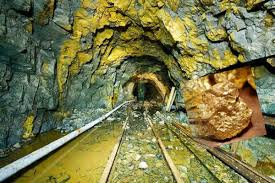
- Given grade (~1–2 g/t) and size, open-cast mining with overburden removal is likely in flatter zones; underground may follow deeper zones. The Bhukia-Jagpura licence mentions open-cast for 2025-26.
- Exploration stages: From G4 → G3 → G2 level of exploration (as per Indian mineral resource classification). Several blocks already at G3 stage (e.g., Dugocha at 1.63 g/t, 1.74 mt resources).
- Downstream: After extraction, ore will need crushing, beneficiation, refining, tailings management, possibly gold recovery and allied metal recovery.
🏛 Regulation, auctions & licences
- The Rajasthan State Mineral Exploration Trust (RSMET) and the Directorate Mines & Geology coordinate e-auction of mineral blocks.
- The state has already auctioned the Dugocha gold block and will likely auction Bhukia-Jagpura blocks. The Times of India+1
- Environmental clearances, tribal rights (especially in Scheduled Areas), mining leases, royalty frameworks will be crucial.
📅 Rough timeline
- With exploration advanced, commercial production could begin potentially by 2025-26 in some blocks (as per some company websites).
- Full ramp-up across the belt may take 5-10 years given infrastructure, processing plants, regulatory clearances.
4. Key opportunities & risks
✅ Opportunities
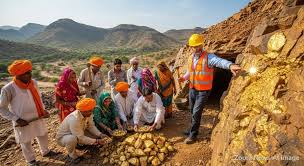
- For local communities: Employment, skill development, infrastructure electrification, schooling.
- For state economy: New revenue streams, clustering of minerals/processing industries (e.g., gold refining, alloy manufacturing, electronics inputs).
- For India: Augmented domestic gold supply, strategic minerals co-recovery (e.g., cobalt, nickel) supporting clean-energy value chains.
⚠️ Risks & Challenges
- Environmental impact: Mining can bring deforestation, dust, water table changes, tailings risks. Need robust environmental safeguards.
- Tribal and local consent issues: Areas like Banswara have tribal populations and Scheduled Area status; mining must conform to rights of indigenous people.
- Market risk: Global gold price fluctuations — if gold price falls, economics may weaken.
- Operational risk: Low grade ore (1–2 g/t) means large volumes and high cost; processing efficiency matters.
- Infrastructure & logistics: Remote area, poor connectivity may delay production or raise costs.
- Regulatory & social licence risk: If local communities oppose or disruptions occur (protests, land issues) mining can stall.
5. What this means for Rajasthan & India
🔍 For Rajasthan
- The southern belt (Banswara‐Ghatol‐Salumbar) is poised to become a mineral growth corridor: gold + allied minerals.
- The state government’s ability to host auctions quickly (e.g., Dugocha) signals proactive mining policy.
- Could diversify the economic base of a mainly agrarian/tribal district into mining + processing + services.
🌐 For India
- Adds to the geology map of Indian gold mining: historically few large gold mines (e.g., Hutti in Karnataka). This broadens mining geography.
- Supports import-substitution for a critical strategic metal.
- If allied minerals (cobalt, nickel) are recovered, helps India’s battery/EV supply chain.
FAQs (for SEO)
Q1. How much gold is in the Banswara reserve?
A: In one block of Bhukia-Jagpura estimated ~113.52 million tonnes of ore, equivalent to ~222 tonnes of gold metal.
Q2. When will mining begin?
A: Some company sources mention 2025-26 for initial production. Full belt maturity will likely take several years.
Q3. Is this the largest gold reserve in India?
A: It is among the largest identified gold belts in Rajasthan; some sources claim the broader SGF belt may contain up to 1,000 tonnes of gold.
Q4. What grade is the ore?
A: Around 1.9 g/t in Bhukia-Jagpura zone in one estimation.
Final thoughts
The discovery of vast gold-ore reserves in Rajasthan’s Banswara district isn’t just a headline—it’s a potential economic game-changer. But the opportunity comes with caveats: the value will only be realised if mining is done responsibly, with technological efficiency, environmental safeguards, and community partnership. For investors, policymakers and local stakeholders alike, this is a story to watch closely.
For more such amazing content visit : https://newseeker.insightsphere.in/







Post Comment