“From Gunfire to Silence: The Rise, Rage and Surrender of ‘Sunita’ — The ₹14 Lakh Bounty Woman of Central India”
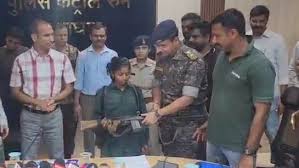
A dramatic investigation into Sunita — a high-value Naxal operative with a ₹14 lakh bounty who surrendered in Balaghat, MP. This feature traces her hard childhood, the violence that shaped her, battlefield moments, the fracture of belief, and what surrender means for her and a scarred region.
The night she walked into the Chauria police camp, Sunita carried two kinds of baggage: a worn rucksack filled with the small, practical things of a life on the run — ration packs, a frayed shawl, a cooking spoon — and an invisible load far heavier: years of gun smoke, blood, fear, and a hatred that had been fed by neglect and violence.
For months, rumours had named her as one of the most wanted figures in the GRB belt — a woman who moved across forests like a shadow, who had stood guard over senior commanders, who had been part of raids that left villages trembling. The state had placed a ₹14 lakh bounty on her head. And then, on November 1, 2025, she surrendered.
What happened between the first angry footprints of her childhood and the slow, public act of surrender is not a linear story of evil or heroism. It is tangled, raw and human: a tale of brutality that hardens people, of promises broken by the state, and of the small, quiet ruptures that finally make someone set down their weapon.
Roots of rage: childhood and recruitment
Sunita’s early life — by most accounts — was a catalogue of hardship. Born in a hamlet whose name changes depending on who’s speaking, she learned young that survival required silence. The forests around Bijapur and Balaghat offered both cover and the resentment of neglect: schools that never opened, clinics without medicines, police vans that came only when there was trouble. Into this vacuum the Maoist movement crept, promising dignity, justice, and a sharp answer to long-standing injustices.
Recruiters find the angry and the abandoned first. They find the hungry, the humiliated, the ones who have seen land taken, relatives disappeared, promises broken. For many, joining is less ideology and more refuge: a place where anger is channelled into purpose. Sunita walked that path in 2022. She learned to read maps by the stars, to stitch uniforms by lamplight, to carry the weight of someone else’s mandate and the heavier burden of her own fear.
Life in the shadow lines: the brutality she saw and lived
Insurgency is not a neat political pamphlet. It is mud, hunger, makeshift hospitals and, at times, brutal reprisals. Those who live in militant zones talk in small confessions: an execution done to send a message; a rationed cup of stolen rice; the night a village was punished for cooperating with officials. Women in armed groups often play complex roles — couriers, cooks, fighters, guardians — and they see intimate cruelties as much as strategic violence.
Sunita’s surrender papers list weapons: an INSAS rifle, magazines, live rounds, an under-barrel grenade launcher shell. Those are blunt facts. The deeper, darker ledger holds faces — the man with an empty chest after an ambush, the child whose eyes glowed because she had never seen a proper schoolroom, the village elder whose land had been taken for a project and who then vanished into rumor. Some of the brutality she witnessed was meted out by state actors, some by her comrades, and some by the ruthless logic of war itself. Each act cracked something inside her, even if at the time she hardened herself against it.
There were moments when ideology sang sweetly — promises of equality, of rights taken back from the powerful. But ideology can be erosive too; when a movement becomes its own lord, when discipline hardens into fear, people begin to keep secrets to survive. Sunita learned to do what was necessary. She learned to hate the system that had ignored her childhood. She learned to obey.
The fracture: why the hardened begin to tremble
Surrender is rarely a single lightning bolt. It is erosion. In the months before she walked into Lanji police station, Sunita’s world closed in. Cross-border operations by state police left safe havens fewer. Supply lines tightened. Leaders she trusted were killed or vanished. The movement’s romantic rhetoric did not pay for medicine when a fever took a comrade. Rumours of infighting and purges crept through the camps.
And then there is the calculus of survival: a price on your head, the knowledge that capture likely means death or long imprisonment, and the contrasting image of an uncertain but legal life beyond the forests. The state’s new surrender and rehabilitation packages — however imperfect — shift that balance. For someone who has seen the worst of both worlds, the option to lay down arms can change from cowardice to the only sane move left.
When she finally entered the camp, Sunita did not deliver a manifesto. She offered small, human things: names of places she had hidden, the weapons she carried, a confession that trembled but did not dramatize. She asked, the police later said, for a chance.
The theatre of surrender: spectacle, shame and a fragile hope
Surrenders are staged for a reason: they send a message. For the state, a high-value surrender is proof that strategy works; for the movement, it is a crack in resolve. For the woman at the centre, it is the last, intimate transaction between her past and a future that may — if the system is humane — offer schooling, employment and safety.
The officials applauded. The Chief Minister called it a triumph of law and policy. Media spokes told neat sentences about “the red corridor shrinking.” But the camera glints cannot erase what comes next: paperwork, verification, courts, and the slow, daily labor of building a life with a name that will now be public.
If Sunita is to be rehabilitated, the state must not only offer a job or compensation; it must help stitch social acceptance and psychological repair. Former cadres face stigma in villages that fear both reprisal and association. Women often confront additional obstacles — family rejection, trauma, and a lack of targeted support.
The larger meaning: a scarred region, a fragile peace
Sunita’s surrender matters less as a trophy and more as a mirror. It reflects decades of neglect, the grinding logic of recruitment, and the way violence begets more violence. It also shows that counter-insurgency that mixes pressure with credible pathways out can work — if the pathways are real and sustained.
But beware triumphalism. A single surrender does not end grievance. It does not remake institutions or rebuild schools. It does not, by itself, heal the wounds that push youth back into the forest. The state’s job is not simply to collect weapons; it is to restore trust. That requires land reform, jobs, healthcare, and local governance that listens — tasks far harder than any brief press conference.
After the gun: what must change
If Sunita’s surrender is to become more than a headline, policymakers must move beyond spectacle. Rehabilitation needs to be comprehensive: medical and psychological care, secure livelihoods that do not stigmatize, community reconciliation programs, and legal clarity. For women, the programs must be gender-sensitive — acknowledging the unique roles and traumas they carry.
For civil society, the lesson is to push for accountability at every level: to document abuses by all actors, to demand education and development in neglected districts, and to hold rehabilitation promises to their word.
Epilogue — a human face, an unresolved ending
When the cameras left, Sunita’s future remained uncertain. The state has written her name into its ledger of “surrenders,” the media has filed its stories, and the politicians have celebrated. But the true story will be told in quieter years: whether she learns a trade, whether old neighbours accept her, whether the rage that once lit her nights fades into something softer. That is the real test of surrender — and of a nation’s capacity to transform.
For more such amazing content visit : https://newseeker.insightsphere.in/





Post Comment